
N150 / N200 JIS Heavy-Duty Truck Batteries — DINWEYS OEM
DINWEYS JIS-standard heavy-duty truck batteries — 145G51 (N150) and 190H52 (N200) models for large trucks, buses and generators. IATF 16949 certified.
Key Takeaways
- **N150 vs N200 is a size-and-output jump** — 135Ah/900A CCA/508×222×212mm vs 200Ah/1100A CCA/520×278×220mm; confirm the tray before upgrading.
- **1100A vs 900A CCA decides cold-start ability** — the N200 turns over the largest engines in cold climates; the N150 fits standard trays in temperate duty.
- **The Pb-Sb thick plate is a deliberate choice** — antimony survives deep cycling and vibration; the trade-off is a serviceable design that needs periodic water checks, not a flaw.
- **220 vs 320 minutes of RC is your engine-off buffer** — lights, telematics and a failed alternator all draw on reserve capacity before the battery dies.
- **A 24V truck is two N200s in series** — replace both together, same model and age, or charging unbalances and the weaker battery fails early.
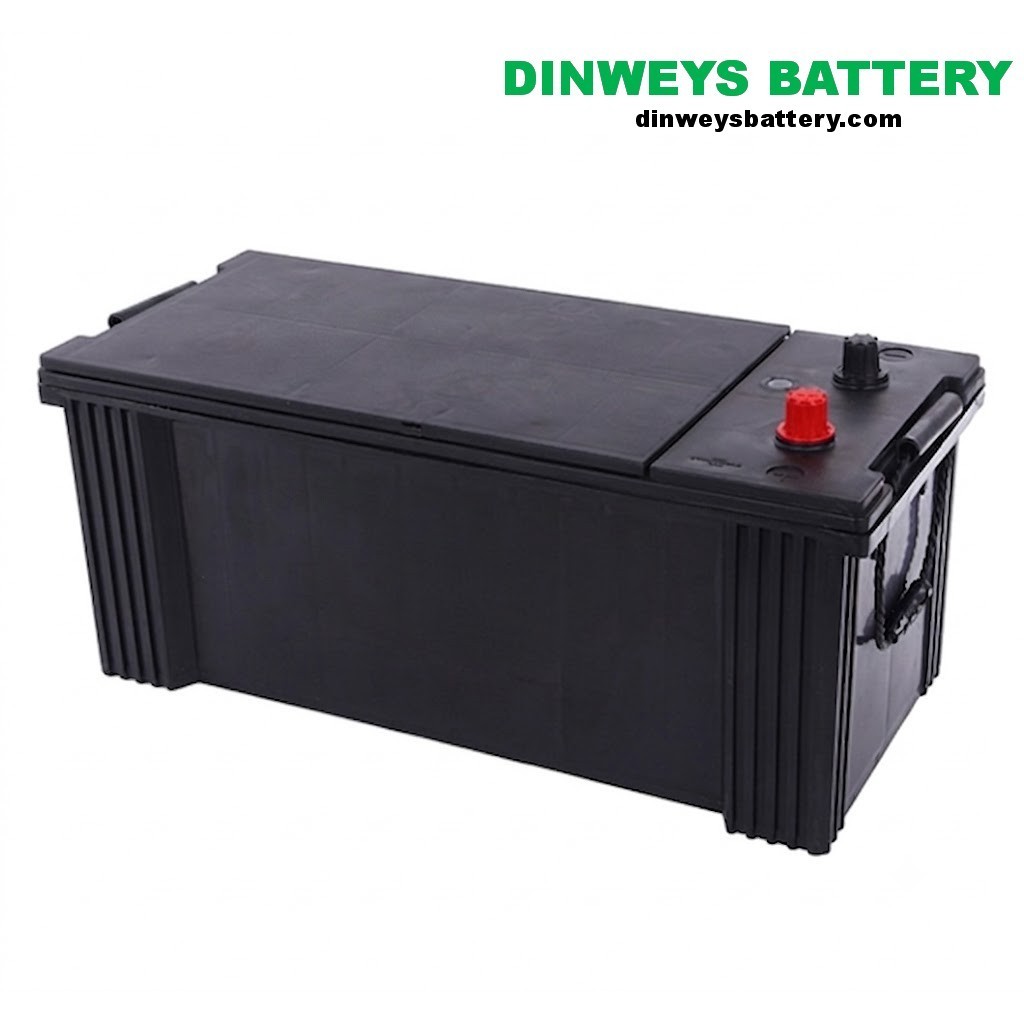
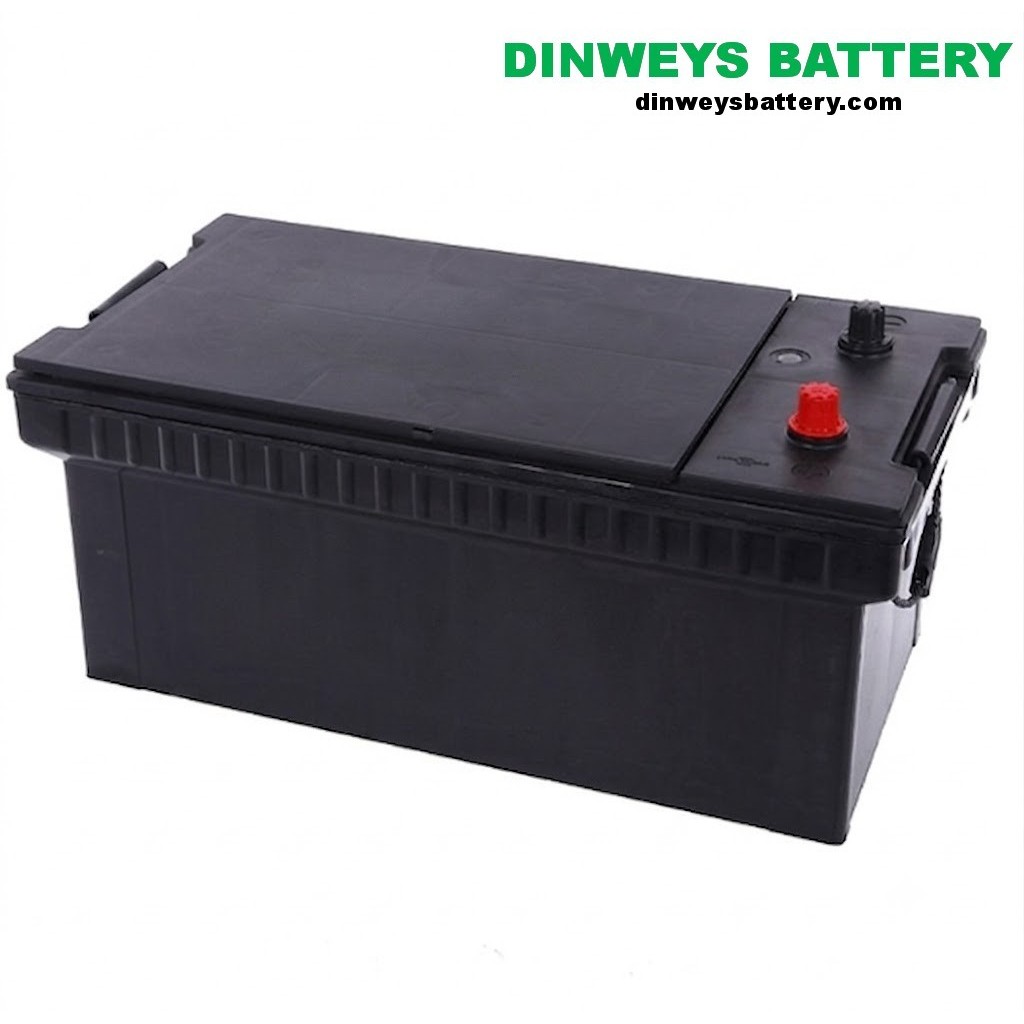
JIS-standard heavy-duty batteries are the workhorse of commercial vehicles across Asia, the Middle East and Africa. The 'N' series (N150, N200) is built on a thick-plate flooded design with a Pb-Sb (lead-antimony) grid — deliberately chosen over thinner automotive plates to survive the deep cycling and vibration of large diesel engines.
The key difference between the two models is size and output. The N150 (145G51) fits standard heavy-truck trays at 508×222×212mm and delivers 900A CCA. The N200 (190H52) is larger at 520×278×220mm and delivers 1100A CCA for the biggest engines and coldest climates. If your tray will take the N200, it is the stronger choice for demanding duty — but always confirm the footprint and terminal orientation before upgrading.
Both are manufactured by Chengguang Power Tech Co., Ltd. under an IATF 16949 quality system, with per-batch CCA test data and full documentation provided with every shipment.
Specifications
| Specification | Value |
|---|---|
| Indicative minimum unit price | From US$80 per unit — final pricing confirmed on quotation (quantity, market and OEM terms apply) |
| Model 145G51 (N150) | 12V, 135Ah (C20), 900A CCA, 220min RC, 508×222×212mm |
| Model 190H52 (N200) | 12V, 200Ah (C20), 1100A CCA, 320min RC, 520×278×220mm |
| Standard | JIS D5301 |
| Technology | Heavy-Duty thick-plate flooded (Pb-Sb grid) |
| Terminals | JIS type A (large post) |
| Applications | Heavy trucks, buses, generators, off-highway equipment |
Specifications are representative for this model. Exact CCA, capacity and dimensions are confirmed per batch on the certificate of analysis — contact us for a full datasheet.
Understanding These Specifications
Cold Cranking Amps (CCA) is measured to JIS D5301 — the current a fully charged 12V battery can deliver for 30 seconds at −15°C while holding at least 7.2V. The N150's 900A and the N200's 1100A describe cold-start power: a higher figure means a stronger, more dependable start on a cold morning.
Reserve Capacity (RC), also to SAE J537, is the number of minutes a fully charged battery can sustain a 25-amp load at 27°C (80°F) before the voltage drops to 10.5V. The N150's 220 minutes and the N200's 320 minutes are your buffer for lights, telematics and other loads when the engine is off — or if the alternator fails on the road.
Capacity is measured at the 20-hour rate (C20). The N150's 135Ah and the N200's 200Ah describe the total energy stored over a slow 20-hour discharge at 25°C — a different measure from the short, high-current burst that CCA describes.
Fit and terminals: both models use JIS type A large taper posts. The N150's 508×222×212mm footprint suits standard heavy-truck trays; the N200 is larger at 520×278×220mm. Confirm tray length, width, height and terminal position before upgrading from N150 to N200.
Model Comparison
| Specification | N150 (145G51) | N200 (190H52) |
|---|---|---|
| Voltage | 12V | 12V |
| Capacity (C20) | 135 Ah | 200 Ah |
| Cold Cranking Amps (JIS D5301) | 900 A | 1100 A |
| Reserve Capacity (SAE J537) | 220 min | 320 min |
| Dimensions (L×W×H) | 508×222×212 mm | 520×278×220 mm |
| Terminals | JIS type A | JIS type A |
| Best for | Standard heavy-truck trays, temperate climates | Largest engines, coldest climates, high electrical loads |
Typical Applications
- Heavy-duty trucks and semi trailers
- Buses and coaches
- Diesel generators
- Off-highway and construction equipment
Application Scenarios in Detail
Heavy-duty trucks and semi trailers
On a semi truck the N-series battery must turn over a large diesel engine after overnight rest and long hauls. The thick Pb-Sb plates and high CCA of the N200 handle repeated cold starts and the vibration of highway operation. On 24V semi trucks, two N200 units are wired in series.
Buses and coaches
City and intercity buses cycle their batteries harder than line-haul trucks — frequent starts, long idle periods and constant accessory load. The N150 and N200's deep-cycling thick plates and generous reserve capacity keep a bus starting reliably through a full service day.
Diesel generators
Standby and prime diesel generators need a battery that holds its charge through long idle periods and then delivers a strong burst when the control system calls for a start. The N-series flooded design tolerates the float-charge life of a generator bay.
Off-highway and construction equipment
Excavators, loaders and mining machines combine heavy vibration, dust and irregular duty. The Pb-Sb grid and robust case of the JIS N-series are chosen to survive conditions where a light automotive plate would fail early.
Maintenance & Care
These are serviceable flooded batteries. Check electrolyte levels periodically and top up with distilled water only when low, keeping the plates covered — never overfill.
Keep terminals clean, tight and lightly greased to prevent corrosion. A loose or corroded connection reduces cranking current and can strain the charging system.
Avoid deep discharge. Recharge promptly after use and store fully charged in a cool, dry place — a battery left partially discharged sulfates and permanently loses capacity.
In a 24V series pair, always replace both batteries together with the same model and age so charging stays balanced.
Frequently Asked Questions
What is the difference between N150 and N200?
The JIS N150 (model 145G51) has 135Ah capacity and 900A CCA; the N200 (model 190H52) is larger with 200Ah and 1100A CCA. Choose based on your engine's CCA requirement and battery tray size.
Are these batteries for 12V or 24V systems?
Each is a 12V battery. Heavy trucks using 24V systems wire two of them in series.
What CCA does a JIS N200 provide?
The 190H52 (N200) provides 1100A CCA (JIS D5301), suited to large diesel engines.
What are the dimensions of the N150 and N200?
The N150 (145G51) measures 508×222×212mm; the N200 (190H52) measures 520×278×220mm. Confirm your battery tray will fit the larger model before upgrading.
Are these batteries maintenance-free?
Heavy-duty JIS models use thick-plate flooded (Pb-Sb) construction, which may require periodic electrolyte checks. AGM versions are available where a maintenance-free option is preferred.
What does Reserve Capacity (RC) mean for a truck battery?
RC is the number of minutes a fully charged 12V battery can sustain a 25-amp load at 27°C before dropping to 10.5V (SAE J537). The N150 offers 220 minutes and the N200 320 minutes — a buffer for lights, telematics and other loads when the engine is off or the alternator fails.
Why do these batteries use a lead-antimony (Pb-Sb) grid?
Antimony strengthens the positive grid and improves resistance to deep cycling, which suits heavy-duty service. The trade-off is slightly higher water consumption, so these batteries are serviceable. AGM versions are available where maintenance-free operation is preferred.
Can I fit an N200 in place of an N150?
Only if your tray and cable routing accept the larger 520×278×220mm footprint (the N150 is 508×222×212mm). Confirm length, width, height and terminal orientation before upgrading.
Explore Other DINWEYS Product Lines
Related Technical Documentation
From the DINWEYS Knowledge Hub.
Technical review — Reviewed by the DINWEYS technical team. Manufacturer: Chengguang Power Tech Co., Ltd. Data source: manufacturer specification and test documentation. Specifications vary by model and standard; confirm final values with the manufacturer.